
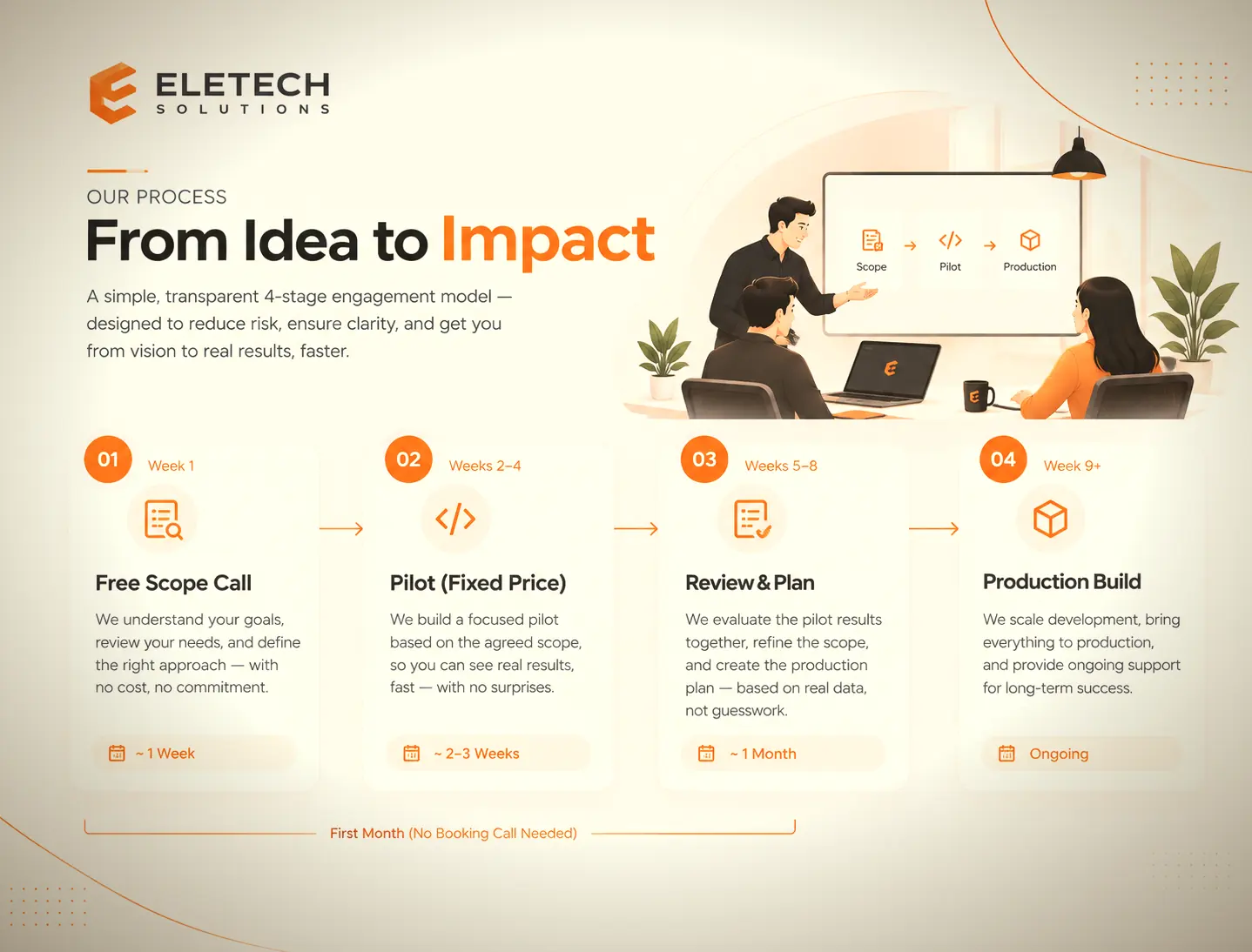
Four stages, with the durations attached.
You should be able to see how the first month runs without booking a call. This is the whole engagement model — the scope call is free, the pilot is fixed-price, and the production scope comes out of the pilot rather than out of a guess.
- Stage 01
Discovery call
We map the process end to end — who touches it, how long it takes, and where it breaks. You leave with a clear view of what is automatable and what is not.
You end up with
- A map of the process as it runs today — every hand-off, system and wait
- A plain list of what is worth automating, and what is not
- A straight recommendation on whether to go ahead, including “don’t build this”
- Stage 02
Design & architecture
We define the system: data flows, model boundaries, integration points, failure handling. You approve an architecture before a line of production code is written.
You end up with
- An architecture you approve: data flows, model boundaries and integration points
- A written plan for failure — what happens when an input is wrong or a system is down
- The build broken into increments, each one something you can test
- Stage 03
Build & integrate
We engineer against your existing stack rather than around it, shipping in increments you can evaluate against real work rather than a demo dataset.
You end up with
- Software wired into the systems you already run, not a parallel copy of them
- Each increment in your hands to evaluate against real work, not a demo dataset
- A system you have already used on live cases before it carries the load
- Stage 04
Run & optimise
Systems are monitored, tuned, and retrained as inputs shift. Several of our automations have run for months of production cycles without a failed run.
You end up with
- Monitoring on every run, so a failure is caught before it reaches you
- Tuning and retraining as your inputs shift, rather than a system that drifts
- A system that keeps pace with your process as it changes
Three things we need, and nothing else.
Every engagement that has gone badly went badly for one of these three reasons, so they are worth saying before the contract rather than after.
- 01
One person who can decide
Not a committee. Someone who can say how the process actually runs today and settle it when two people describe it differently.
- 02
Access to the real data
A sample of the genuine thing, not a cleaned-up export. Almost every surprise in a build lives in the rows nobody wanted to show us.
- 03
An hour a week
Enough to look at what we deployed and say whether it matches the job. Less than that and we are guessing on your behalf.
Tell us what the process costs you today.
That number decides whether any of this is worth building. Bring it to the call and we can get to a straight answer inside half an hour.
- Emailsupport@eletech.io
- RepliesWithin one working day
30 min · no charge
Pick a time and we’ll talk it through.
- 30 min, and no charge for it
- Bring the process and what it costs you today
- A straight answer — including “don’t build this”